
Cibolo City Directory Collections by Regional Lead
Historical directory work for Cibolo begins with a limit that matters. The inspected official holdings do not verify a standalone Cibolo city-directory series. Instead, the best documented leads are Seguin volumes, state holdings, and broader Texas collections. A person associated with Cibolo can appear under a Seguin, Schertz, rural Guadalupe County, or postal-city heading. Keep the volume title in the research note, because a regional hit is a lead, not evidence that the directory covers all of Cibolo.
| Collection lead | Years | Where held | Access |
|---|---|---|---|
| Seguin City Directory catalog record | 1976 | San Antonio Genealogical and Historical Society catalog | Catalog lead; confirm physical holding and completeness |
| Seguin City Directory catalog record | 1978 | Regional inventories and the society catalog | Catalog lead; publisher attribution varies |
| Seguin city directories | 1982, 1985 | Texas State Library and Archives Commission | On-site Reference Reading Room; staff do not search by phone or email |
| U.S. City Directories collection | 1822-1995 | Participating library databases | Coverage varies by town and year |
The collection trail also includes broader Texas directory collections and the digitized Portal to Texas History collection. Neither inspected source verified an exact Cibolo or Seguin run beyond the listed leads. Start with the confirmed year and place, then ask the holding institution about adjacent years rather than filling a gap with an assumed annual issue.
Cibolo City Directories Start with Seguin
The San Antonio Genealogical and Historical Society catalog records a 1976 Seguin City Directory with the publisher shown as unknown. Its 1978 entry is also a catalog lead, while a second entry gives a different publisher attribution. That uncertainty belongs in the citation. It is not a reason to invent a publisher, a complete run, or a Cibolo section that has not been inspected.
The society catalog also lists the local-history title Cibolo Texas, the Early Years. It can help establish a regional vocabulary, but it is not a directory substitute. Search surnames with initials, maiden-name variants, and the surrounding postal labels. When a person is not under Cibolo, try Seguin, Schertz, and rural Guadalupe County before treating the absence as final.
The society catalog view is the source for this regional lead.
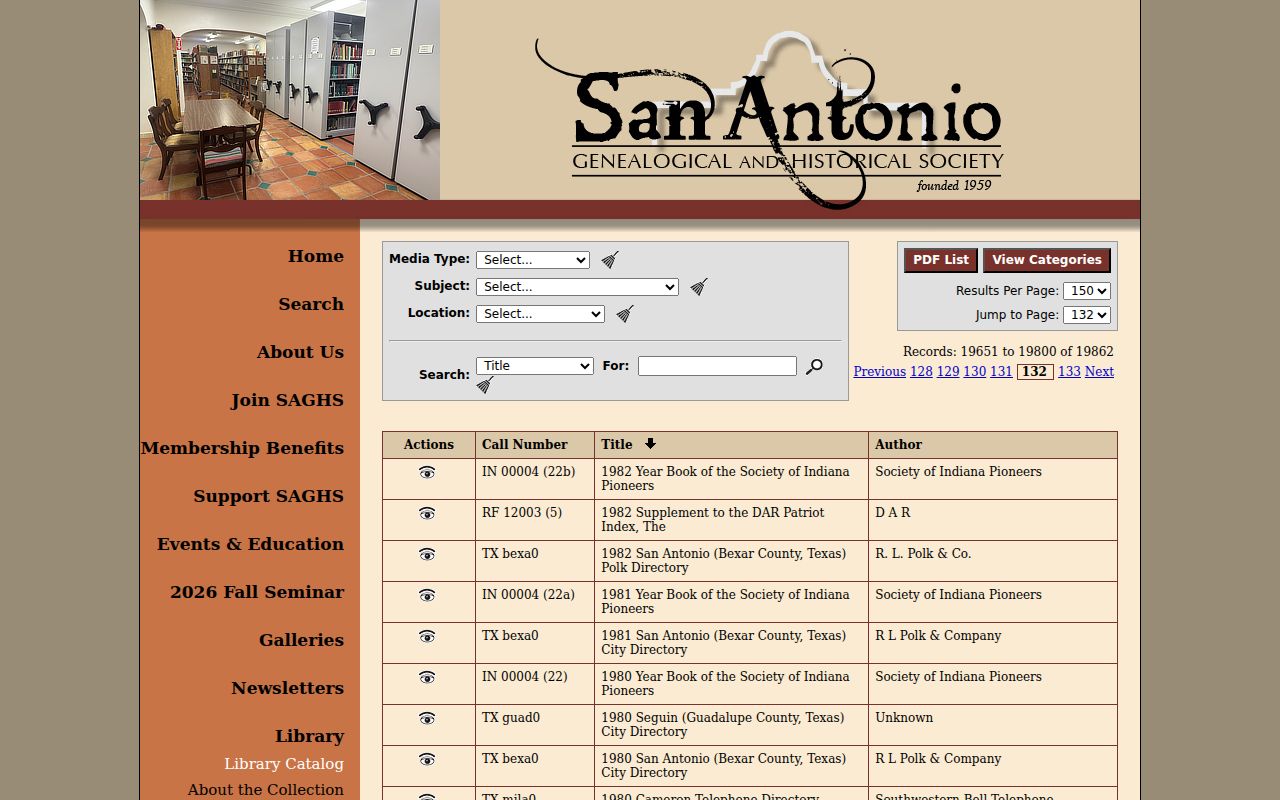
The screen documents discovery information, not a scanned directory page, which is why a holding and page image should be verified before drawing a household conclusion.
Cibolo City Directory Leads at TSLAC
The Texas State Library and Archives Commission city-directory holdings list names Seguin for 1982 and 1985. Those volumes are available in the on-site Reference Reading Room. TSLAC states that staff do not search city directories by telephone or email, so a search should arrive with a surname, year, and likely regional label. Its research guide also points readers toward library databases, the Portal to Texas History, and other Texas collections when the state list has a gap.
For Cibolo research, the list supports a careful sequence: inspect the listed Seguin years, then compare a person or address against Schertz and wider regional variants. It does not prove that a missing name was absent from Cibolo. The city developed within a changing county and metropolitan geography, and directory publishers may have used a different postal or municipal label.
The TSLAC holdings list identifies the verified Seguin years.
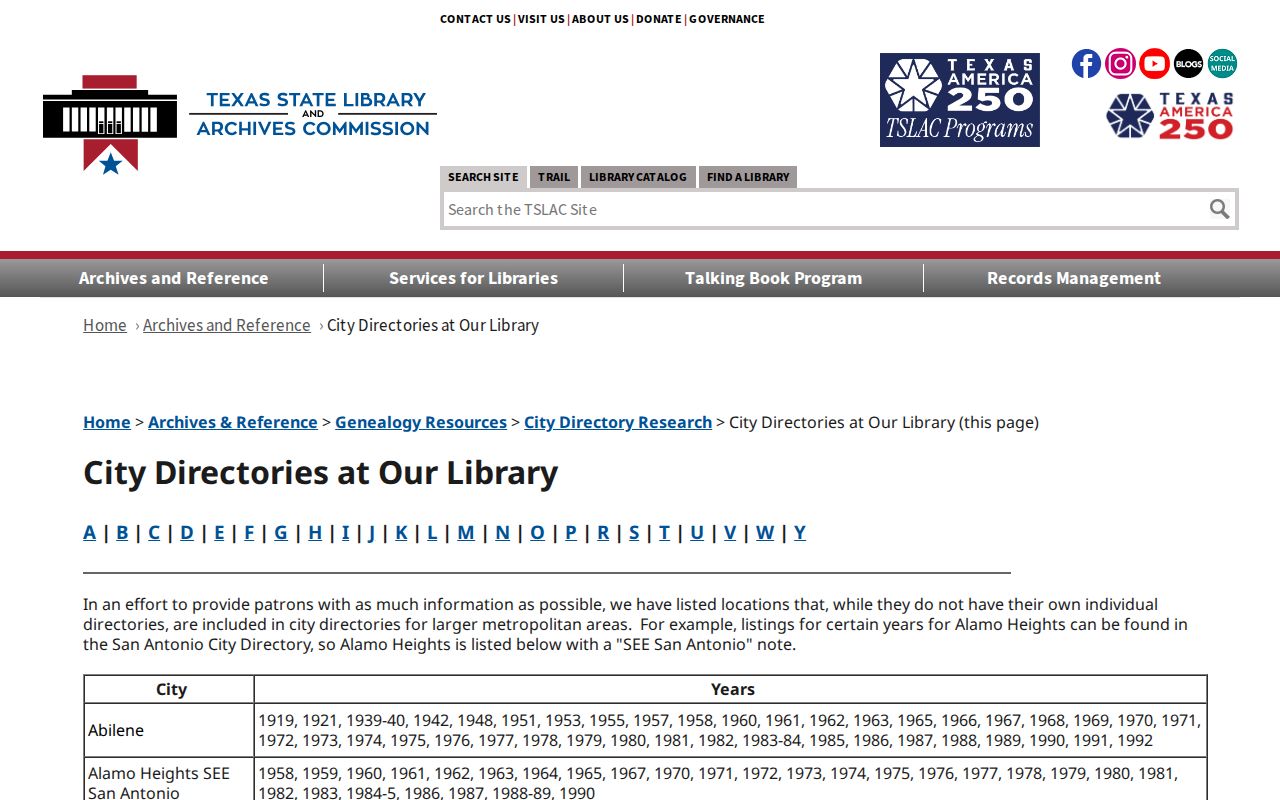
Use the holdings entry to plan an on-site request, then record the exact volume consulted and the section searched.
Cibolo City Directory Timeline Is Regional
The verified chronology is short and regional, but it is still useful for planning a search. It tracks catalog and holdings evidence, not a continuous Cibolo publication run. Each date marks a volume or a lead that can be requested, browsed, or checked with the holding institution.
- 1976: A Seguin City Directory catalog record appears with publisher listed as unknown.
- 1978: A second Seguin catalog record appears, with publisher attribution requiring confirmation.
- 1982: TSLAC lists a Seguin city directory in its on-site holdings.
- 1985: TSLAC lists another Seguin city directory in its on-site holdings.
There is no verified standalone Cibolo issue before, between, or after those dates in the inspected official catalogs. Record gaps as gaps, then use newspapers, census material, tax rolls, and regional directory headings to continue the household trail.
Reading a Cibolo City Directory Entry
Because no accessible local sample entry was verified, the safest way to read a Cibolo city directory lead is through the field pattern described by the TSLAC city-directory research guide. A directory-style entry can combine identity, address, telephone, spouse, and occupation information. Some volumes add an owner or renter notation. The visible abbreviation key and front matter control the meaning of each mark, so photograph or transcribe that key before assigning a meaning to a letter.
| Name | Surname, given name or initials, often with a spouse or widow notation where the volume uses one. |
|---|---|
| Residence | Street address, house number, and sometimes an apartment or room marker. |
| Telephone | A listed number when the particular volume includes one. |
| Occupation line | Occupation, employer, or business information when printed, useful for separating same-name entries. |
| Tenure notation | A possible owner or renter mark, but only when the volume's own key defines it. |
- Criss-cross directory
- A street-order section that can connect an address to an occupant or business when that volume includes it.
- Householder index
- An index organized around the head of a listed household rather than every person at an address.
- Abbreviation key
- The volume's front-matter explanation for marks such as widow, apartment, office, or residence abbreviations.
The TSLAC guide supplies the field schema used for this inventory.
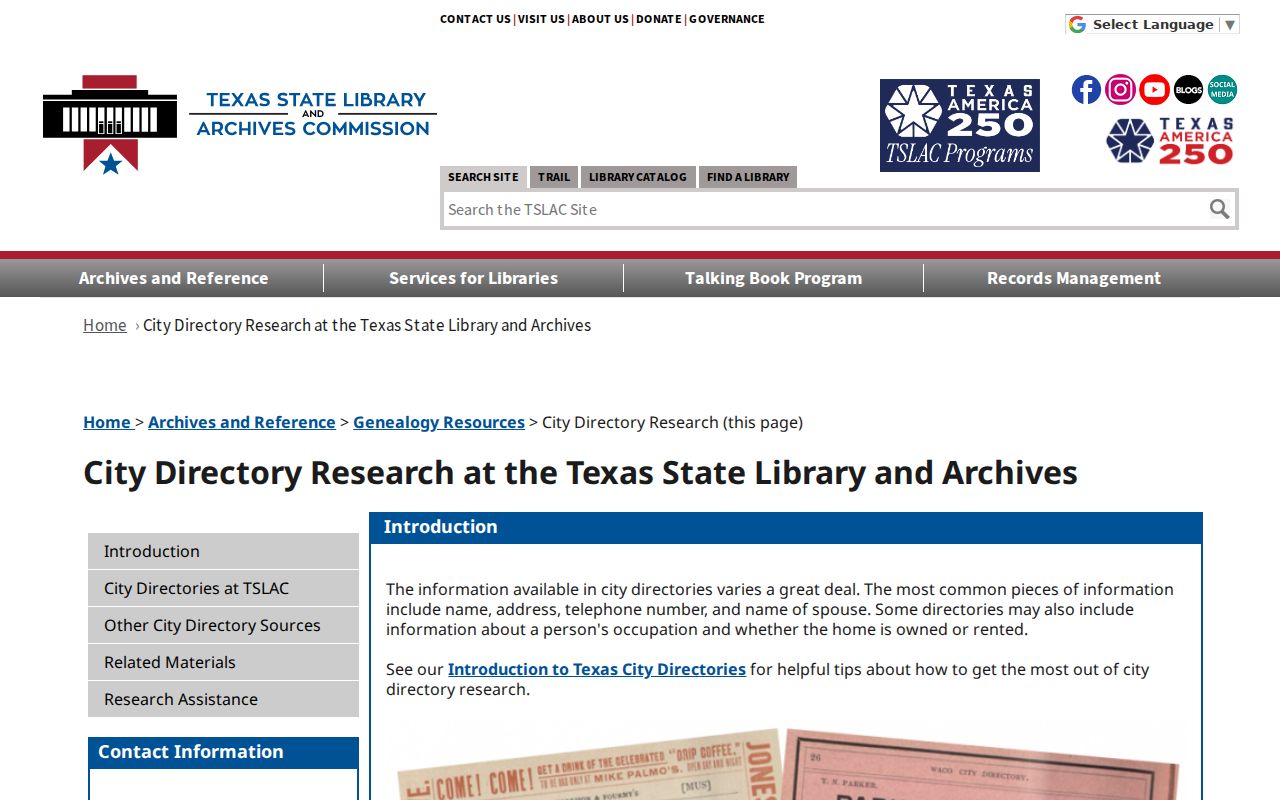
The guide supports a field-by-field reading method while leaving the actual wording and symbols to the specific directory volume.
Cibolo City Directory Browsing Has a Scan Gap
The Portal to Texas History city-directory collection provides free browsing for digitized material, including an inspected 1976 browse view. The text-only inspection did not open an individual Seguin or Cibolo entry. That makes the portal a useful discovery channel, not proof of a local page image. Note the item title, publisher, year, and page number whenever a scan becomes available.
Catalog and browse systems can disagree on labels. Search the surname and the regional place terms separately, then test address or business clues inside the volume. A failed browse result may mean the relevant issue was not digitized, not that the person never appeared in a printed directory.
The Portal to Texas History browse screen shows the digitized discovery route.
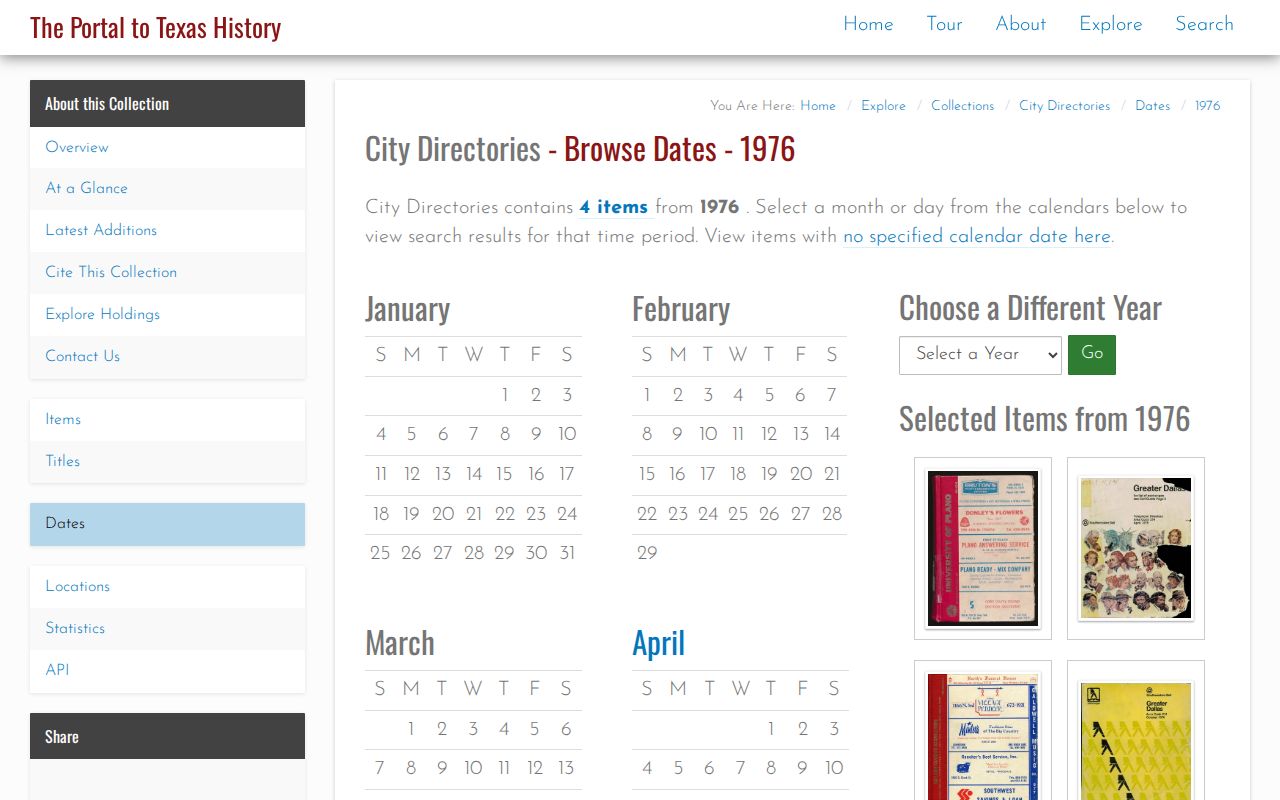
This collection is most useful for locating a candidate issue before relying on an item-level scan or an in-person holding.
Tracing Cibolo City Directories with Census Years
A Cibolo city directory trail gains value when each entry is treated as one dated snapshot. Begin with the newest available regional volume and preserve each spelling, initial, spouse clue, address, and street suffix. A reverse section, if present, can help check whether the address points to the same name. Then work through the verified Seguin leads and nearby regional headings rather than assuming a continuous local series.
- Search the alphabetic and street-order sections of the newest regional directory for the surname and known address.
- Copy the exact printed spelling, initials, spouse notation, address, and any visible abbreviation.
- Move backward through 1985, 1982, 1978, and 1976 leads, also trying Seguin, Schertz, and postal-city headings.
- Pair a directory snapshot with the public 1940 or 1950 federal census, using the Seguin library's Texas census microfilm or HeritageQuest access.
- Confirm a move, death, or transfer with an appraisal, deed, probate, obituary, or permit record rather than the directory alone.
A name that disappears can reflect a move, a death, a changed spelling, a different publication label, or a skipped issue. It does not settle which event occurred. If a historical name needs a current independent check, use the separate Cibolo resident lookup workflow rather than treating a directory line as a modern result.
Note: Federal census access follows a 72-year release rule, so directory years help bridge the long intervals between public census snapshots.
Cibolo Directory Gaps Meet Seguin Newspapers
The strongest local-history bridge is the Seguin Public Library Local History Room. Its second-floor collection includes late-1890s-to-current Seguin Gazette-Enterprise and Gazette microfilm, other local newspapers, Sanborn maps, Texas census microfilm, a genealogy computer, and staff help during operating hours. This is a story of two access periods: NewsBank begins in 2005 for cardholders, while older newspaper work remains on microfilm.
Search an address change, marriage notice, obituary, school item, or organization notice by surname and date. Those notices can explain why a directory line changes, but they still need a separate record check when identity matters. Cibolo residents also qualify for Schertz Public Library services through the shared service arrangement, while the deeper historical inventory is in Seguin.
The Seguin Heritage Museum archives page is the source for this Guadalupe County historical resource.
The museum's public holdings describe Guadalupe County history and can provide community context, but it does not present a searchable resident database.
Cibolo City Directory Companion Sources
When the regional directory shelf is thin, companion sources add a different kind of evidence. Seguin Public Library lists yearbooks including El Toreador, El Toro, Navarro High School titles, The Matador, PEDAGOG, and The Growl, although donated runs are incomplete. Its library databases include in-library Ancestry, Heritage Hub, HeritageQuest, NewsBank, and genealogy products. Catalog search should come before a visit because a title does not promise a complete sequence.
The TSLAC Guadalupe County microfilm guide adds deed records, deed-of-trust records, tax rolls, and direct and reverse index reels. For a deceased family member, the Schertz-Cibolo Cemetery Atlas record identifies 220 graves and a 1900-active burial span. That count makes it a meaningful local family-history lead, but cemetery data is not proof of a current address.
Cibolo City Directory Limits to Keep
A city directory is neither a complete roster nor a deed. It may omit people, use a regional heading, carry publication lag, or apply a local abbreviation differently than another volume. Cibolo's suburban growth also means a modern parcel can have detailed appraisal and map data without an older directory line, while an older Seguin-area family may be visible in newspapers or tax rolls without a present-day Cibolo street address.
Preserve the source, volume year, page, heading, and search date. Those details make a regional directory lead useful to the next library, archive, or county-record search without overstating what the page proves.